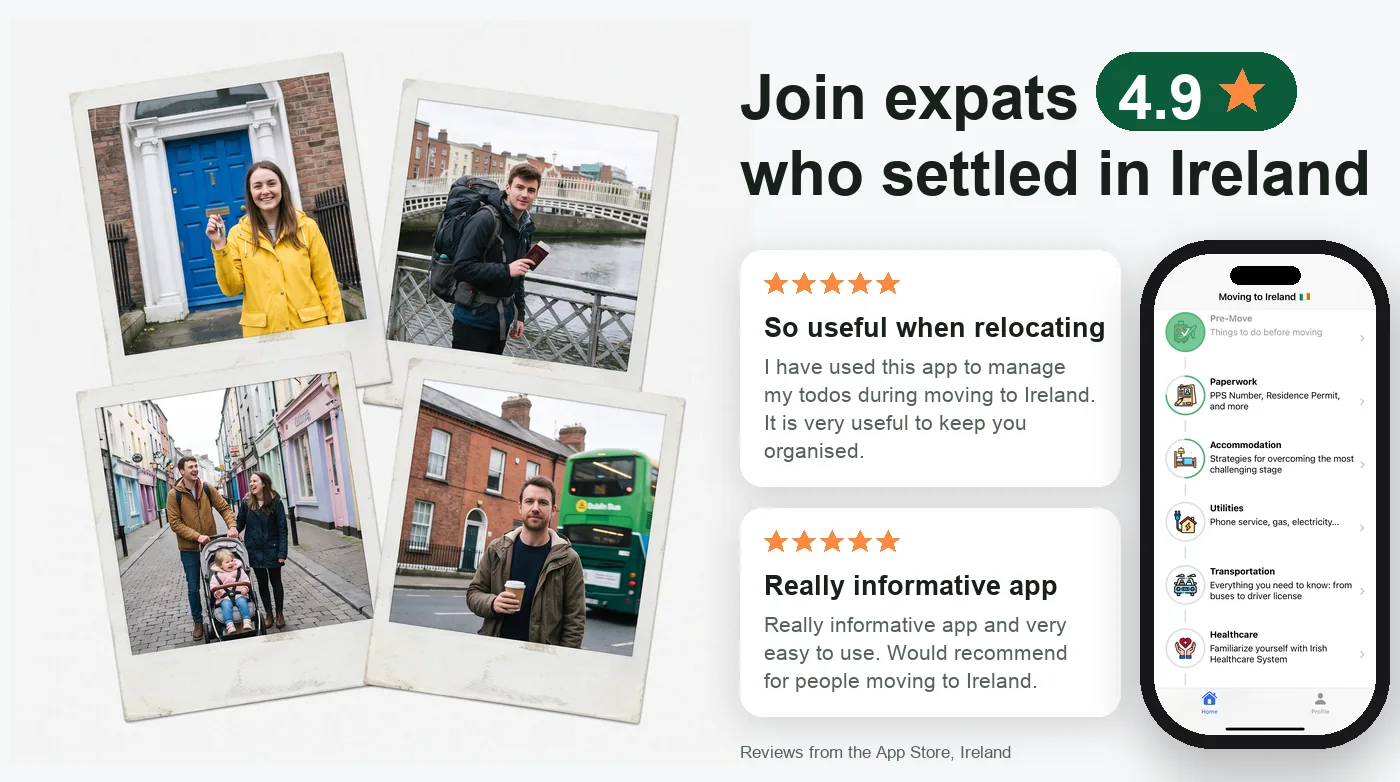
Kuwait has a large expatriate workforce, so people moving from Kuwait to Ireland are usually Indian, Egyptian, Filipino, Pakistani or Lebanese professionals who have spent years in the Gulf and want a permanent home, along with Kuwaiti students heading to Irish universities, especially for medicine and engineering. Healthcare, tech, finance and construction are the typical sectors. The surprise for anyone arriving from Kuwait is how much of Irish life happens outdoors despite the weather: walking, cycling and standing outside pubs in the rain.
| Quick facts | Kuwait to Ireland |
| Visa to enter | Yes, long stay D visa |
| Permission to stay beyond 90 days | Yes, needs a permit or scheme, then an IRP |
| Kuwaiti licence exchangeable | No |
| Double taxation agreement | Yes |
| Social security agreement | No |
| Pets | Unlisted country, rabies blood test |
Do you need a visa?
Yes. Kuwaiti citizens are visa required, so you need an Irish visa before you travel and then an immigration permission to stay. For a move the visa is a long stay D visa, applied for online through AVATS and submitted with your passport and documents to the Irish embassy or visa office that covers Kuwait, or through its VFS partner where one is used. Allow at least eight weeks. The visa gets you to the border; your permission to live here comes from the permit, course or family relationship behind it. You cannot enter on a short stay C visa and switch to a work permission from inside Ireland.
- Critical Skills Employment Permit for jobs on the critical skills list (from 1 March 2026 the minimum salary is 40,904 euro, or 68,911 euro for other eligible roles). Spouses and partners can join you and work on Stamp 1G without their own permit, and you can apply for Stamp 4 after two years.
- General Employment Permit for most other jobs, minimum salary 36,605 euro from 1 March 2026, usually after the employer runs a labour market needs test. Healthcare assistants, home carers, chefs and construction trades come in on this permit.
- Stamp 2 study permission for a degree or a recognised English language course, with the right to work 20 hours a week in term time (40 in the holidays). Graduates of Irish degrees get the Third Level Graduate Programme (Stamp 1G) to look for work for one to two years.
- Family routes if you are joining an Irish citizen, an EU citizen exercising treaty rights, or a permit holder.
Whichever route you take, you must register for an Irish Residence Permit (300 euro) within 90 days of arriving: online in Dublin, or at the local Garda immigration office elsewhere. If you have an Irish born parent or grandparent, check the Foreign Births Register first, because once registered you are an Irish citizen and none of the above applies.
Finding work and getting your qualifications recognised
English is the working language in Kuwait, so most arrivals speak it fluently, though Irish accents and slang take adjusting to. Employers rarely ask for a certificate, but universities and professional registration bodies do, even for fluent speakers. Irish is on signs but not needed.
Because most routes need a job offer first, the search happens from home. Irish CVs run to two pages, carry no photo and no date of birth, and lead with what you did rather than your job title. Most hiring runs through LinkedIn, IrishJobs, Jobs.ie and the employers' own sites; agencies are strong in tech, finance, pharma and healthcare, and employers used to sponsoring permits say so in the advert. Get your degree assessed by NARIC Ireland (free, through QQI) before you apply; it maps a Kuwaiti qualification onto the Irish framework and employers recognise the letter. Regulated professions register with their own body: nurses with NMBI, doctors with the Medical Council, teachers with the Teaching Council, engineers with Engineers Ireland, and physiotherapists, radiographers and social workers with CORU. Those bodies, not employers, are the ones that ask for an English test.
Your driving licence
Kuwait is not on the NDLS list of recognised states, so you cannot swap a Kuwaiti licence for an Irish one. You can drive on your Kuwaiti licence for up to 12 months as a visitor, ideally with an International Driving Permit, but once you are resident you must go through the Irish process: pass the driver theory test, get a learner permit, complete Essential Driver Training and pass the driving test. The good news is that experienced foreign licence holders only need 6 EDT lessons instead of 12 and can skip the usual six month wait before the test. Learner permit holders must be accompanied by a full licence holder, which is the part that catches people out. Remember that Ireland drives on the left.
Tax, pensions and money
Ireland and Kuwait have a double taxation agreement, so income taxed in one country is generally credited in the other and the treaty decides which country taxes what. You become Irish tax resident after 183 days in a tax year (or 280 days over two years), and from then Ireland taxes your worldwide income, with credit for Kuwaiti tax under the treaty. Register with Revenue through myAccount as soon as you have a PPS number so your employer taxes you correctly, and tell the Kuwaiti tax authority that you are leaving.
There is no social security agreement between Ireland and Kuwait, so the two records stand alone. You need at least 520 paid PRSI contributions (ten years) to qualify for any Irish State Pension (Contributory), and the full rate takes 40 years of contributions. Check whether your Kuwaiti state pension can be paid to you in Ireland, and whether you can keep contributing voluntarily from abroad.
Your credit history does not follow you. Irish lenders only see the Central Credit Register, so expect to build a record from scratch before a mortgage or car loan. Moving money from the Kuwaiti dinar into euro is cheapest through a specialist transfer provider rather than a bank; open the Irish account first, because you need an Irish IBAN to receive salary.
Healthcare
Ireland has a public system run by the HSE, but it is not free at the point of use. Once you are ordinarily resident (living in Ireland or intending to for at least a year) you use public hospitals as a public patient, and inpatient charges were abolished in April 2023. A GP visit costs roughly 50 to 70 euro unless you qualify for a medical card or GP visit card on income grounds (children under 8 get GP visits free), and prescriptions are paid for up to a monthly cap under the Drugs Payment Scheme. Emergency departments charge 100 euro without a GP referral. Students, Stamp 0 holders and most visa applicants must show private medical insurance, so many people arrive with a policy already.
Around half the population holds private health insurance from VHI, Laya or Irish Life Health, mainly to shorten waiting lists. If you are 35 or older, buy it within 9 months of arriving to avoid a Lifetime Community Rating loading. Register with a GP as soon as you have an address; practices in Dublin often have closed lists, so ask several.
Bringing your things and your pet
Goods arriving from Kuwait are imports from outside the EU. You can bring your household belongings free of duty and VAT under Transfer of Residence relief if you have lived outside the EU for at least 12 months and owned the goods for at least 6 months; your removals company files the declaration and you cannot sell the goods for a year. A car qualifies for VRT relief on the same terms, but shipping a car from Kuwait rarely makes sense once freight, registration and Irish insurance are added up.
Kuwait is an unlisted country under the EU pet rules, which adds a blood test. Your dog, cat or ferret needs a microchip, then a rabies vaccination, then a rabies antibody titre test at least 30 days after the vaccination at an EU approved laboratory, and then a three month wait from the date of the blood sample before travel. Add an EU animal health certificate issued within 10 days of travel and, for dogs, a tapeworm treatment 24 to 120 hours before arrival. Pets must arrive as manifest cargo or with an approved airline on an approved route (Dublin Airport handles most). Start the process at least four months before you fly.
Settling in: community and daily life
The Kuwaiti community in Ireland is very small, mostly students and medical graduates in Dublin, while the broader group of people who have lived in Kuwait is larger and spread across the cities. Newcomers connect through university societies, mosque communities, Gulf alumni networks and WhatsApp groups of former colleagues.
Life in Kuwait runs on cars, air conditioning and late nights; in Ireland you walk more, dress in layers and find shops closing early. Petrol and domestic help are expensive rather than cheap, groceries cost more, and payments are by card. Weekends are Saturday and Sunday, and driving is on the left.
There are no regular direct flights between Dublin and Kuwait, so getting home usually means one stop, most often via London, Paris, Istanbul, Doha or Dubai; budget for the time as well as the fare.
First 30 days checklist
- Apply for a PPS number through MyWelfare.ie with your passport and proof of Irish address.
- Register for your Irish Residence Permit within 90 days (300 euro); book the appointment the week you land because slots fill up.
- Register with Revenue myAccount once you have a PPS number so your employer can tax you correctly.
- Open an Irish bank account; a utility bill, tenancy agreement or employer letter usually counts as proof of address.
- Register with a GP and, if you want it, buy private health insurance within 9 months.
- Get a Leap card for public transport and book the driver theory test if you plan to drive.
- If a pet is following later, get its rabies blood test done now so the three month clock is running.