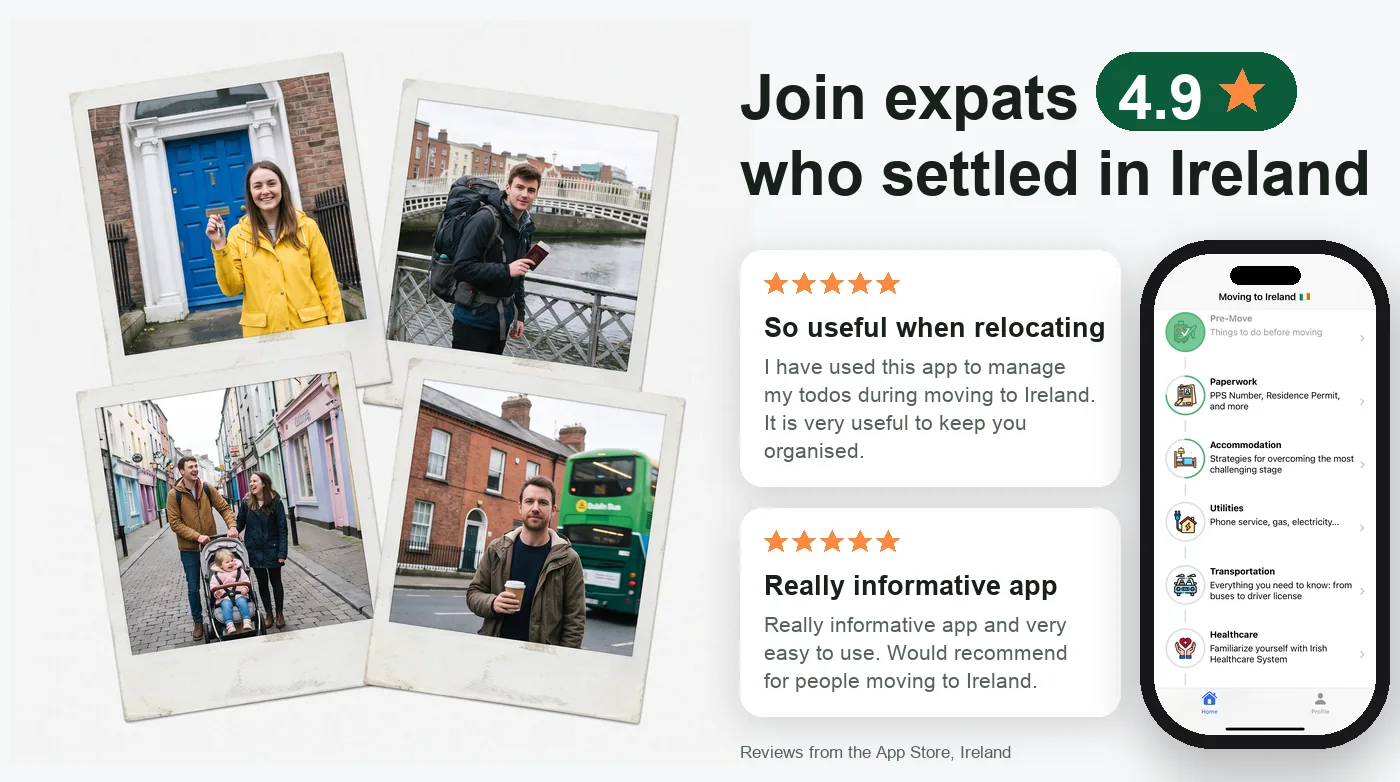
France has one of the largest European communities in Ireland, drawn by jobs in tech, finance, pharma, aviation and hospitality, by Irish universities and by the long tradition of young French people spending a year in Dublin to perfect their English. Many arrive on internal transfers or as new graduates and find the career ladder faster and flatter than at home. Couples and families follow. The surprise for most French people is the Irish approach to food and meals: lunch at the desk, dinner early, and the pub rather than the table as the centre of social life.
| Quick facts | France to Ireland |
| Visa to enter | No: EU free movement |
| Permission to stay beyond 90 days | No permit or registration needed |
| French licence exchangeable | Drive on it, swap it when it expires |
| Double taxation agreement | Yes |
| Social security agreement | Yes, via EU rules |
| Pets | EU pet passport |
Do you need a visa?
No. As an EU citizen you have the right to free movement: you can enter Ireland with a passport or national identity card, look for work, take a job, study or set up a business without a visa, an employment permit or any registration with immigration. There is no Irish Residence Permit for EU, EEA and Swiss citizens. After three months you are expected to be working, self-employed, studying, or able to support yourself, but nobody checks at a desk; it only comes up if you later apply for something like citizenship.
The picture changes for family. A spouse, partner or dependent parent who is not an EU, EEA or Swiss citizen can join you under EU Treaty Rights: they may need a visa to enter, and once here they apply to Immigration Service Delivery for a residence card (form EU1) within their first months, which gives them Stamp 4 EU FAM and the right to work. Applying early matters because the card can take months.
If you have an Irish parent or grandparent you may already be entitled to Irish citizenship through the Foreign Births Register. It changes nothing about your right to live here, but an Irish passport is handy for family members and for voting.
Finding work and getting your qualifications recognised
French speakers arrive with a wide range of English, and many use their first year in Ireland precisely to become fluent. Irish employers rarely ask for a test score, but universities and professional bodies do. Irish appears on signs and announcements alongside English but is not needed in daily life.
You can apply for jobs from home and start the week you land. Irish CVs run to two pages, carry no photo and no date of birth, and lead with what you did rather than your job title. Most hiring runs through LinkedIn, IrishJobs, Jobs.ie and the employers' own sites, with recruitment agencies strong in tech, finance and pharma. EU qualifications are recognised under EU rules, so a nurse, doctor, teacher or engineer registers with the Irish body without re-qualifying, though registration itself takes weeks to months.
Your driving licence
A full French licence is an EU or EEA licence, so you can keep driving on it in Ireland for as long as it is valid; there is no exchange deadline. Most people swap it for an Irish licence when it expires or when they want a local card for identification, which the NDLS does without a test for 65 euro. Apply online at ndls.ie with a Public Services Card and MyGovID, or book an NDLS centre appointment with the licence, proof of your PPS number, proof of address and photo ID. Once you exchange it, Irish rules apply: a lifetime licence becomes a ten year one, and category B does not include the trailers or motorcycles it may have covered at home.
Tax, pensions and money
Ireland and France have a double taxation agreement, so income taxed in one country is generally credited in the other and the treaty decides which country taxes what. You become Irish tax resident after 183 days in a tax year (or 280 days over two years), and from then Ireland taxes your worldwide income, with credit for French tax under the treaty. Register with Revenue through myAccount as soon as you have a PPS number so your employer taxes you correctly, and tell the French tax authority that you are leaving.
Social security follows the EU coordination rules. You pay into one system at a time, your French contribution record and Irish PRSI record are combined to qualify for a state pension in either country, and each country pays its share when you retire. If your employer is posting you to Ireland temporarily, an A1 certificate keeps you in the French system. Occupational and private pensions can generally stay where they are.
Your credit history does not follow you. Irish lenders only see the Central Credit Register, so expect to build a record from scratch before a mortgage or car loan. Being in the euro area spares you exchange costs, and SEPA transfers from home arrive the next day.
Healthcare
Your European Health Insurance Card covers you as a visitor, not as a resident. Once you are ordinarily resident (living in Ireland or intending to for at least a year) you use public hospitals as a public patient, and inpatient charges were abolished in April 2023. The HSE is not free at the point of use the way many French services are: a GP visit costs roughly 50 to 70 euro unless you qualify for a medical card or GP visit card on income grounds (children under 8 and people over 70 get GP visits free), and prescriptions are paid for up to a monthly cap under the Drugs Payment Scheme. If your employer is posting you here on an A1, an S1 form registers you with the HSE at French expense.
Around half the population holds private health insurance from VHI, Laya or Irish Life Health, mainly to shorten waiting lists. If you are 35 or older, buy it within 9 months of arriving to avoid a Lifetime Community Rating loading. Register with a GP as soon as you have an address; practices in Dublin often have closed lists, so ask several.
Bringing your things and your pet
Goods move freely inside the EU, so a removals van from France clears no customs. A car registered in France must be registered for Vehicle Registration Tax within 30 days of arrival; VRT relief applies if you owned and used the car for at least 6 months abroad and are moving your normal residence to Ireland, and you then need Irish insurance, motor tax and an NCT.
Pets travel on an EU pet passport: a microchip, a rabies vaccination given at least 21 days before travel, and for dogs a tapeworm treatment by a vet 24 to 120 hours before arrival, which Ireland requires because it is free of the tapeworm. Ferries and airlines carry pets on set routes, and the animal is checked on arrival.
Settling in: community and daily life
The French community in Ireland is large and long-established, with a strong presence in Dublin and smaller groups in Cork, Galway and Limerick. Newcomers find each other through the Alliance Française, the French school and lycée network, French Catholic Mass, Facebook and WhatsApp groups, sports clubs and regular consulate and cultural events.
The climate is greyer and wetter than most of France and the winter days are short, but summers are long and light. Renting is more expensive and less protected than in France, and groceries and eating out cost more, with fewer bakeries and markets. Tipping is light, shops open on Sundays, and the working day starts and ends earlier with a much shorter lunch.
Getting home is straightforward: there are direct flights between Dublin and France, and Cork and Shannon add more routes in summer.
First 30 days checklist
- Apply for a PPS number through MyWelfare.ie with your passport and proof of Irish address.
- No IRP is needed. Register with Revenue myAccount once you have a PPS number so your employer can tax you correctly.
- Open an Irish bank account; a utility bill, tenancy agreement or employer letter usually counts as proof of address.
- Register with a GP and, if you want it, buy private health insurance within 9 months.
- Get a Leap card for public transport; your licence needs nothing until it expires.
★ Useful links
- Citizens Information: residence rights of EU nationals
- Immigration Service Delivery: family members of EU citizens
- National Driver Licence Service
- Revenue: moving to Ireland
- Bilateral social security agreements and EU rules
- Department of Agriculture: bringing your pet to Ireland
- Health Insurance Authority